Doppler ultrasound uses harmless sound waves to view pictures of blood flow inside your blood vessels. This test can find narrow or blocked arteries and veins.
How do I get ready for an ultrasound?
The test takes 30 to 60 minutes. Allow time to check in. When you arrive, you may be asked to undress from the waist down or to change into a gown. The person who does the ultrasound is called a sonographer.
What to tell the sonographer
Tell your sonographer if:
-
You’ve had a stroke.
-
You’ve had symptoms, such as short-term loss of strength, problems with speech or vision, or pain or swelling in your arms or legs.
What happens during an ultrasound?
The ultrasound may be done on your neck, abdomen, leg, or arm. This depends on where the problem is.
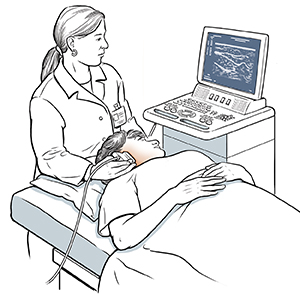
If the test is done on your neck
-
You will lie on an exam table.
-
Your head will be turned to the side.
-
Nongreasy gel will be applied to your neck.
-
The sonographer will then press a handheld transducer (probe) against your neck.
If the test is done on your abdomen, leg, or arm
-
Nongreasy gel will be applied to the skin over the area to be examined.
-
The probe will be pressed against the skin over the gel.
A sonographer can answer questions about the test. But only a health care provider can explain the results.
Your test results
Before you leave, you may need to wait briefly while your images are being reviewed. Your health care provider will discuss the test results with you during a follow-up appointment or over the phone.
Your next appointment is:____________________
Online Medical Reviewer: Anne Fetterman RN BSN
Online Medical Reviewer: Deepak Sudheendra MD
Online Medical Reviewer: Raymond Kent Turley BSN MSN RN
Date Last Reviewed: 03/01/2025
© 2000-2026 The StayWell Company, LLC. All rights reserved. This information is not intended as a substitute for professional medical care. Always follow your healthcare professional's instructions.