Endocervical curettage is a procedure to take some tissue from inside your cervix. This tissue is sent to a lab. It is checked for any problems, such as cancer.
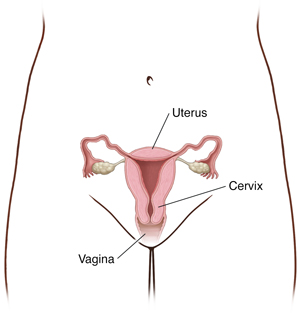
The cervix is the narrow, lower part of your uterus. It opens up into your vagina. The length of the cervix is called the cervical canal.
How to say it
ehn-doh-SER-vih-kuhl kuhr-ruh-TAHZH
Why endocervical curettage is done
You may need this done if you have abnormal bleeding from your uterus. It can help find out the cause. It may be done as part of testing after an abnormal Pap test. It may also be done to remove growths (polyps) or other reasons for the bleeding. Endocervical curettage is not done during pregnancy.
How to prepare for endocervical curettage
The procedure is best done when you are not having your period.
For at least 24 hours before the procedure you should not douche, use tampons, use vaginal medicines, or have sex.
How endocervical curettage is done
You can have this done in a hospital. Or it may be done at an outpatient clinic.
During the procedure:
-
You may be given medicine so you don’t feel pain. You may be awake or asleep.
-
The health care provider puts a tool called a speculum into your vagina. It helps them see your cervix better.
-
The provider cleans the cervix with a special solution.
-
A tool called a tenaculum is used to grasp the cervix. It holds the cervix in place.
-
The provider puts a tool called a curette into the cervical canal.
-
Then they gently scrape a thin layer of tissue from high inside the wall of the cervical canal.
-
The tissue sample is removed and put on a cotton pad or into a small jar filled with preservative solution. The sample is sent to a lab to test for any problems.
-
There may be cramping (similar to a menstrual cramp) during and after the procedure.
Risks of endocervical curettage
-
Bleeding
-
Infection
-
Injury to the cervix
-
Pain and cramping
-
Tear in the uterus
Featured in
Author: Semko, Laura
Online Medical Reviewer: Daphne Pierce-Smith RN MSN
Online Medical Reviewer: Lalitha Kadali
Online Medical Reviewer: Tennille Dozier RN BSN RDMS
Date Last Reviewed: 04/01/2025
© 2000-2025 The StayWell Company, LLC. All rights reserved. This information is not intended as a substitute for professional medical care. Always follow your healthcare professional's instructions.