Your baby has been diagnosed with hypospadias. This is an issue with the penis. About 5 in every 1,000 males born in the U.S. each year have this condition. Hypospadias can range from minor to severe. This sheet tells you more about your child’s condition.
How to say it
hi-puh-SPAY-dee-uhs
What is hypospadias?
The tube that carries urine and sperm out of the body is called the urethra. It runs inside the penis and normally opens at the tip of the penis. With hypospadias, the opening of the urethra is on the underside of the penis instead. In more severe forms of hypospadias, the opening is in the middle or base of the penis. Rarely, the opening may be down near the scrotum. Or it may be between the scrotum and the anus.
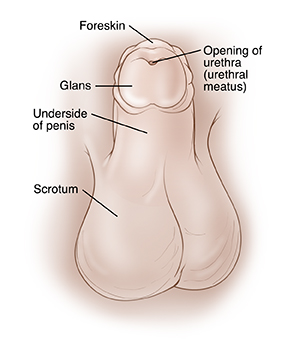
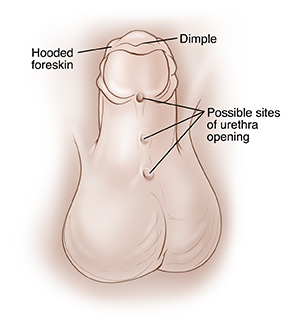
What causes hypospadias?
Hypospadias is something a child is born with (congenital condition). In most cases, the cause is unknown.
Certain things may be associated with the condition, such as:
-
Family history.
-
Genetic factors that affect the development of the urethra.
-
Mother's age over 35.
-
Mother who is overweight or obese.
-
Some hormones, medicines, or environmental factors that the mother comes in contact with. These include:
-
Women who took certain hormones just before or during pregnancy.
-
Women exposed to estrogens found in pesticides used in fruits and vegetables or in plastic linings.
-
Women who used assisted reproductive technology (fertility treatments) to help with pregnancy.
-
What are the signs of hypospadias?
A child with hypospadias has a urethra that doesn't open at the tip of the penis. They may also have:
-
A penis that curves downward (chordee).
-
A foreskin that doesn’t cover the glans (dorsal hood).
-
Abnormal spraying of urine.
How is hypospadias diagnosed?
Hypospadias may be seen at your newborn’s physical exam. If hypospadias is found during circumcision, the circumcision should be stopped. The baby should be referred to a urologist right away.
How is hypospadias treated?
In mild cases, the urethra may not need correction. In moderate to severe cases, your child may need surgery to correct how the penis looks. Children with hypospadias may not be circumcised as newborns. This is because the foreskin can be used to repair the urethra in the future. The repair surgery is often done when the child is
What are the long-term concerns?
Left untreated, mild hypospadias often carries no long-term problems. But in more serious cases, it can be hard for the child to urinate normally while standing. They may need to sit down to urinate. In severe cases, an adult with untreated hypospadias may have trouble delivering sperm and getting a woman pregnant.
Featured in
Online Medical Reviewer: Chelsey Schilling BSN RN
Online Medical Reviewer: Raymond Kent Turley BSN MSN RN
Online Medical Reviewer: Vinita Wadhawan Researcher
Date Last Reviewed: 06/01/2025
© 2000-2026 The StayWell Company, LLC. All rights reserved. This information is not intended as a substitute for professional medical care. Always follow your healthcare professional's instructions.