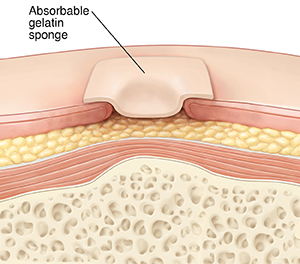
An absorbable gelatin sponge is a material used in fresh open wounds to stop bleeding. It's put directly on the base of the wound. It helps the blood form a clot. Another bandage is put on top of the dressing. This protects it and keeps it in place.
The material that touches the wound base will dissolve or fall off with the scab. Any material that’s left may be taken off during a follow-up visit.
Home care
These guidelines will help you care for your wound at home.
Dressing care
Keep the dressing dry until the next dressing change or visit with your doctor. Bathe with your dressing out of the water. If it's on an arm or leg, protect the dressing with a large, rubber-banded or taped plastic bag. Make sure that the rubber bands aren't too tight, cutting off circulation. If the dressing can't be covered with a bag, you may have to take a sponge bath around it. If the dressing gets wet, it must be changed.
Changing the dressing
If you were advised to change the dressing at home:
-
Wash your hands with soap and clean, running water.
-
Remove the outer bandage covering the absorbable dressing.
-
The outer bandage might stick to the absorbable dressing because of blood in the bandage. If that happens, gently run warm water over the dressing. Do this until the dried blood softens and you can peel the outer bandage away. Be careful not to pull the absorbable dressing off the wound.
-
If the warm water method alone doesn't loosen the bandage, pour hydrogen peroxide over the dressing. This will help soften the dried blood.
-
If this doesn’t work and you're having trouble, return to this facility. Let us replace the dressing for you.
-
After you've removed the bandage, wash your hands again. Rinse the wound area with soap and water. Look at the area around the wound. Check for redness, swelling, or pus.
-
Put an antibiotic ointment over the absorbable dressing. This is to keep it from sticking to the new bandage. Put on another bandage. Or a large adhesive bandage.
Other precautions
-
No tub baths or swimming until the bandage is removed and the wound is healed. This will take at least 7 days.
-
If you were given an appointment for a wound check or dressing change, keep this appointment.
Follow-up care
Follow up with your doctor as advised. Most open wounds heal in 10 to 14 days. But even with correct treatment, a wound infection may sometimes occur. Check the wound every day for any signs of infection listed below.
When to get medical advice
Contact your doctor right away if you have:
-
Pain in the wound that gets worse, or doesn't improve with pain medicine.
-
Redness, swelling, or pus coming from the wound.
-
A bad smell from the wound.
-
A fever of 100.4ºF (38ºC) or higher, or as advised by your doctor.
-
Chills.
-
Bleeding that can’t be easily controlled by putting direct pressure on the wound.
Online Medical Reviewer: Daphne Pierce-Smith RN MSN
Online Medical Reviewer: Mahammad Juber MD
Online Medical Reviewer: Melinda Murray Ratini DO
Date Last Reviewed: 04/01/2025
© 2000-2026 The StayWell Company, LLC. All rights reserved. This information is not intended as a substitute for professional medical care. Always follow your healthcare professional's instructions.