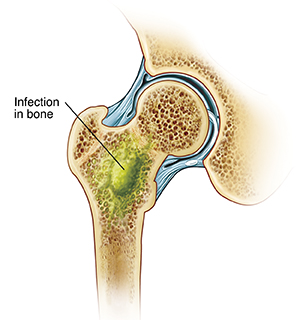
Your child has been diagnosed with osteomyelitis. This is an infection of a bone by a germ (bacteria or fungus). In children, infection in the long bones of the arms and legs is most common. Your child may be referred to an orthopedist (specialist in bone and joint problems) or an infectious disease specialist (specialist in infections). This is for evaluation and treatment.
What causes osteomyelitis?
Germs, such as bacteria and fungi, can cause osteomyelitis. The most common type of bacteria that causes osteomyelitis is called Staphylococcus aureus or staph. The bacteria and fungi can enter the body through:
-
Infected wounds or joints.
-
Infections that spread from another part of the body.
-
Broken bones that break through the skin.
-
A foreign object that breaks the skin.
Those at higher risk for bone infection include children who:
-
Have no spleen.
-
Are on dialysis.
-
Have sickle cell disease.
-
Are being treated with immunosuppressive medicines, such as chemotherapy.
-
Have diabetes.
But any child can get this infection. In some cases, the cause of the infection is never known.
What are the symptoms of osteomyelitis?
Get medical help right away if your child:
-
Has a fever of
100.4 °F (38 °C) or higher, or as advised by your child's doctor. -
Has chills.
-
Has pain in the bone.
-
Has swelling of the arms or legs.
-
Has redness or warmth of the skin on the arms or legs.
-
Has pus draining from the skin.
-
Won't let you touch their arms or legs.
-
Can't use their arms or legs. (Their limb is unable to hold weight.)
-
Is cranky or lethargic, refuses to eat, or vomits (in babies).
An infection often happens from a recent injury. Symptoms of the infection can be masked by the symptoms of an injury. Because of this, it might take longer to notice the infection. It's important to bring your child to their doctor if symptoms don't get better quickly.
How is osteomyelitis diagnosed?
If the doctor thinks that your child may have osteomyelitis, tests may be done. These include:
-
An X-ray of the area to look for infection.
-
Blood tests to confirm infection and find the germ that's causing the infection.
-
Imaging tests, such as a bone scan, a CT scan, an MRI, or an ultrasound.
-
A biopsy (procedure to take a sample of bone) to find the germ that's causing the infection.
How is osteomyelitis treated?
At first, treatment often takes place in the hospital. The treatment may include:
-
Antibiotic or antifungal medicines, given through an I.V. (intravenous) line or by mouth (oral).
-
Pain medicine.
-
Surgery to clean out the infected area in and around the bone.
Your child may be given antibiotics for 4 to 6 weeks. This can be done using a PICC line (peripherally inserted central catheter) at home. In other cases, your child may be able to have oral antibiotics. This will depend on how they've responded. It also depends on the specific germ causing the infection.
Long-term concerns
Most children recover completely. Although rare, complications can occur. They include:
-
Blood clots.
-
Growth problems.
-
Abnormally shaped bones.
-
Broken bones (fractures).
-
Joint stiffness.
-
Death of bone tissue.
Online Medical Reviewer: Raymond Turley Jr PA-C
Online Medical Reviewer: Stacey Wojcik MBA BSN RN
Online Medical Reviewer: Thomas N Joseph MD
Date Last Reviewed: 05/01/2025
© 2000-2025 The StayWell Company, LLC. All rights reserved. This information is not intended as a substitute for professional medical care. Always follow your healthcare professional's instructions.