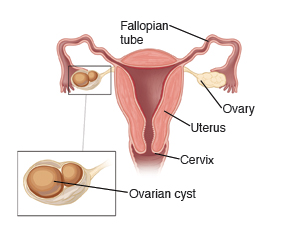
The ovaries are 2 small organs located on each side of the womb (uterus). They are part of the female reproductive system. Ovarian cysts are sacs filled with fluid or tissue that form on or inside the ovaries.
Ovarian cysts are common, especially during childbearing years. There are different types of cysts. Most are harmless (benign) and go away on their own. They often cause no symptoms. If symptoms do occur, they can include mild pain or pressure in the lower belly (abdomen).
Cysts that are large can break (rupture) and bleed. This is called a hemorrhagic cyst. It may cause more severe pain and symptoms. In these cases, you may need hospital care or treatment, such as surgery. You may need more extensive treatment if a cyst makes an ovary twist (called torsion) or if your doctor suspects your cyst is cancerous. But keep in mind that most cysts are not cancerous.
General care
-
To help relieve pain, your doctor may recommend using over-the-counter pain medicine. If needed, your doctor may prescribe stronger pain medicine.
-
Using heat may help relieve your pain. Consider using a heating pad set on low or a warm water bottle. Taking a warm bath may help you feel more comfortable.
-
Depending on the type of cyst you have, your doctor may advise taking birth control pills. These help shrink cysts in certain cases. They may also help prevent new cysts from forming. If they are prescribed, be sure to take them as directed.
-
Your doctor may ask you to watch your symptoms over time to see if they go away or get worse. Regular ultrasound tests may also be advised. They can help check if a cyst goes away or grows in size.
Follow-up care
Follow up with your doctor as advised.
When to contact your doctor
Contact your doctor right away if:
-
Your pain gets worse or doesn't get better with home treatment.
-
You have a fever of 100.4°F (38°C) or higher, or as directed by your doctor.
-
You have nausea and vomiting.
-
You have weakness, dizziness, or fainting.
-
You have abnormal vaginal bleeding.
Featured in
Online Medical Reviewer: Daniel N Sacks MD
Online Medical Reviewer: Donna Freeborn PhD CNM FNP
Online Medical Reviewer: Heather Trevino
Date Last Reviewed: 07/01/2025
© 2000-2026 The StayWell Company, LLC. All rights reserved. This information is not intended as a substitute for professional medical care. Always follow your healthcare professional's instructions.