A cesarean section (C-section) is a type of surgery. It's the birth of a baby through a cut (incision) in the mother’s belly. A C-section may be planned and scheduled. But, in many cases, a C-section is not planned. In any case, it is done to make sure that you and your baby have the safest birth.
Before the procedure
You will be given antibiotics. This is to reduce any risk of infection. Most C-sections take less than 1 hour. Your healthcare team is ready to take care of you and your newborn. Your partner may be with you for the birth.
During the procedure
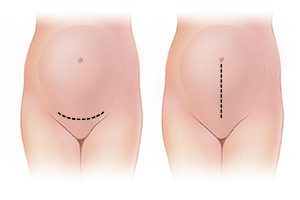
The surgery will start after you have anesthesia. You will have either regional or general anesthesia. Regional numbs you below the waist. General makes you go to sleep. Incisions are made in your skin and then your uterus. These 2 incisions may differ. Make sure they are noted in your health records. Here is how they may vary:
-
The skin incision. This cut is usually side to side. This is known as transverse. It is done at the pubic hairline. An up and down (vertical) incision may be used if you’ve had this incision before. Or it may be used if the C-section needs to be done quickly.
-
The uterus incision. This is most often transverse. This type heals very well. It may let you have a future vaginal birth (VBAC). In some cases, a vertical incision may be made instead.
Once the incisions are made, the healthcare provider presses on the top of the uterus. They guide the baby out through the incisions. The cord will be clamped and cut. Then the placenta is lifted out through the incision.
After the procedure
After your baby’s birth, the uterus incision is closed with stitches. Your skin incision will be closed with surgical staples or stitches. A dressing will be put on it. Your healthcare provider will press on your belly. This helps expel blood clots through the vagina. You may be given medicines. These are to help shrink your uterus. They can decrease your bleeding.
Your baby's care after birth
Your baby will be placed in an infant warmer. Gentle suction will be used to help remove excess fluid from your baby’s mouth and airways. Then the APGAR score will be done. This rates a baby’s:
-
Appearance (skin color showing healthy blood flow)
-
Pulse (heart rate)
-
Grimace (muscle reflex)
-
Activity (muscle tone)
-
Respiration
Your baby will be wrapped in a blanket and brought to you. Now, for the first time, you’ll see your newborn.
Risks of a C-section
As with any surgery, a C-section has risks. Your healthcare provider will discuss the risks with you. They may include:
-
Bleeding
-
Infection
-
Injury to nearby organs
-
Blood clots in the legs, pelvis, or lungs
-
Reaction to anesthesia
Online Medical Reviewer: Donna Freeborn PhD CNM FNP
Online Medical Reviewer: Heather M Trevino BSN RNC
Online Medical Reviewer: Irina Burd MD PhD
Date Last Reviewed: 12/01/2022
© 2000-2025 The StayWell Company, LLC. All rights reserved. This information is not intended as a substitute for professional medical care. Always follow your healthcare professional's instructions.