Correct care can help your baby’s umbilical cord heal. Don't pull or pick at the cord. It should fall off on its own within 2 weeks after the birth. Use the steps below as a guide.
Caring for your baby’s umbilical cord
To help prevent infection and keep the cord dry:
-
Keep the cord open to the air.
-
Fold down the top edge of the diaper, so the diaper will not cover or rub against the cord.
-
Don't dress your baby in clothing that constricts the cord.
-
Don't place your baby in bath water. Wait until the cord has fallen off and the area where the cord was attached is dry and healing. Instead, give your baby a sponge bath with a washcloth.
-
Don't try to remove the cord. It will fall off on its own. It's normal to see a small amount of crusty blood on the umbilical cord. It may also bleed a small amount and stain the baby's shirt when the cord is about to fall off.
-
Don't use rubbing alcohol on the cord.
When to contact your baby’s doctor
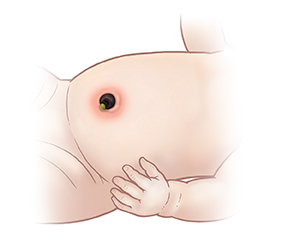
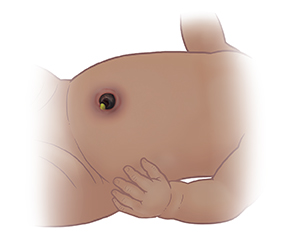
Contact your baby's doctor if:
-
You see redness or swelling around the cord.
-
There is discharge or bad odor coming from the cord.
-
The cord doesn’t fall off by 4 weeks after the birth.
-
Your baby has a fever (see Fever and children, below).
Fever and children
Use a digital thermometer to check your child’s temperature. Don’t use a mercury thermometer. There are different kinds and uses of digital thermometers. They include:
-
Rectal. For children younger than 3 years, a rectal temperature is the most accurate.
-
Forehead (temporal). This works for children age 3 months and older. If a child under 3 months old has signs of illness, this can be used for a first pass. The doctor may want to confirm with a rectal temperature.
-
Ear (tympanic). Ear temperatures are accurate after 6 months of age, but not before.
-
Armpit (axillary). This is the least reliable but may be used for a first pass to check a child of any age with signs of illness. The doctor may want to confirm with a rectal temperature.
-
Mouth (oral). Don’t use a thermometer in your child’s mouth until they are at least 4 years old.
Use a rectal thermometer with care. Follow the product maker’s directions for correct use. Insert it gently. Label it and make sure it’s not used in the mouth. It may pass on germs from the stool. If you don’t feel okay using a rectal thermometer, ask your child's doctor what type to use instead. When you talk with any health care providers about your child’s fever, tell them which type you used.
Below is when to contact the doctor if your child has a fever. Your child’s doctor may give you different numbers. Follow their instructions.
When to contact the doctor about your child’s fever:
For a baby under 3 months old:
-
First, ask your child’s doctor how you should take the temperature.
-
Rectal or forehead: 100.4°F (38°C) or higher
-
Armpit: 99°F (37.2°C) or higher
-
A fever of ___________as advised by the doctor
Featured in
Online Medical Reviewer: Daphne Pierce-Smith RN MSN
Online Medical Reviewer: Stacey Wojcik MBA BSN RN
Online Medical Reviewer: Tracy C. Garrett RNC-NIC BSN
Date Last Reviewed: 06/01/2025
© 2000-2026 The StayWell Company, LLC. All rights reserved. This information is not intended as a substitute for professional medical care. Always follow your healthcare professional's instructions.