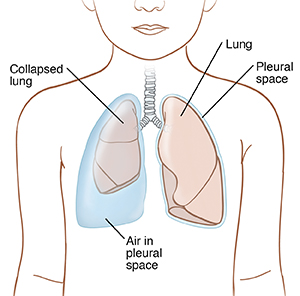
The space between the lung and chest wall is called the pleural space. Pneumothorax happens when air leaks out of the lung and is trapped there. The air presses on the lung and can cause part or all of the lung to collapse.
What causes pneumothorax?
There are several types of pneumothorax. Each type has a different cause.
-
Traumatic pneumothorax. This type occurs when an injury damages the lung and causes a leak. The injury may be due to such things as a blow, fall, car crash, or broken rib.
-
Primary spontaneous pneumothorax. This happens when there is a weakened spot (bleb) on the surface of the lung. Most children with blebs have no related health problems and no symptoms. But if a bleb breaks, pneumothorax results.
-
Secondary spontaneous pneumothorax. This happens because of lung disease. It's more likely to happen in children with problems like cystic fibrosis or asthma.
-
Iatrogenic pneumothorax. This develops as a complication of another medical procedure. Examples include central venous line placement (when a large IV is placed in a vein in the upper chest or neck) and mechanical ventilation using a ventilator.
What are the symptoms of pneumothorax?
Symptoms of pneumothorax vary for each child. The most common symptoms include:
-
Sharp, stabbing type chest pain that may spread to the shoulder and back.
-
Shortness of breath or trouble breathing.
-
Fast, shallow breathing.
-
Dry cough.
-
Tiredness.
In more severe cases, symptoms can also include:
-
Fast heartbeat.
-
Blue, purple, or gray color to the skin caused by lack of oxygen (cyanosis).
-
Sudden collapse or shock.
How is pneumothorax diagnosed?
The doctor will examine your child and listen to your child’s heart and lungs through a stethoscope. The doctor will keep an eye on your child's oxygen levels. This is done with a monitor connected to sticky pads on your child's finger or toe, or with blood tests. A chest X-ray will be done to see how bad the leak is. In some cases, your child may get a CT scan or an ultrasound. Together, these tests provide detailed pictures of the lungs.
How is pneumothorax treated?
The doctor will watch your child’s symptoms. Your child will be given breathing support with oxygen, and by a ventilator if needed. The doctor can also look for any existing health problems or injuries that your child may have and treat them.
If the leak is small and the symptoms are under control, your child may be sent home without any more treatment. A small pneumothorax usually heals on its own. But it's more common for children to stay overnight in the hospital. This is done to make sure the pneumothorax doesn't grow and need more treatment.
If the leak is large, your child will be admitted to the hospital. Your child may get one or more of these treatments:
-
Aspiration. A needle is inserted between the ribs into the pleural space. This helps remove the leaked air, so breathing can return to normal.
-
Chest tube placement. A thin tube is placed between the ribs and into the pleural space. It's then left in place. The tube is attached to a suction device that removes the leaked air. This helps the lung expand fully again. The tube may be left in place for a few days while the leak in the lung heals.
-
Surgery. This may be done if other treatments don't close the leak. It may also be done if your child has had more than one pneumothorax. During surgery, blebs may be removed or sealed off. Treatment may also be done to make the surface of the lung thicker and harder to break. The doctor will tell you more about surgery for your child if it is needed.
What are the long-term concerns?
Most children do well after treatment. But they have higher risk of having another pneumothorax in the future. To help prevent this, your child may be advised not to do certain activities like scuba diving and frequent air travel. Children with lung disease are at higher risk to have continued problems after treatment. They will need regular visits to their doctor to manage their health and condition.
Call 911
Severe pneumothorax can be fatal if not treated. Call 911 right away if:
-
Your child has sudden, sharp, stabbing chest pain. It may spread to the shoulder and back, and it gets worse with deep breaths or coughing.
-
Your child has severe shortness of breath or trouble breathing.
-
The skin has a bluish color from lack of oxygen.
-
Your child faints.
-
Your child has a fast heartbeat.
Featured in
Online Medical Reviewer: Dan Brennan MD
Online Medical Reviewer: Daphne Pierce-Smith RN MSN
Online Medical Reviewer: Mahammad Juber MD
Date Last Reviewed: 06/01/2025
© 2000-2026 The StayWell Company, LLC. All rights reserved. This information is not intended as a substitute for professional medical care. Always follow your healthcare professional's instructions.