Surgery for COA is done by a pediatric heart surgeon. The surgery lasts about 4 to 6 hours. You may stay in the waiting room during surgery.
-
Before surgery. You’ll be told not to let your child eat or drink for a certain amount of time before surgery. Follow these instructions closely.
-
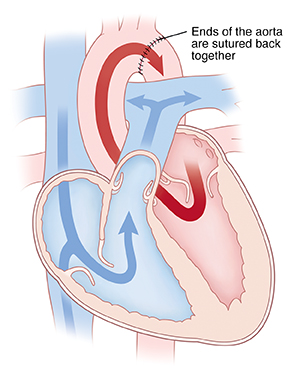
During surgery. Your child is given medicine (sedative or anesthesia) to help them sleep and not feel pain during surgery. A breathing tube is placed in your child’s trachea (windpipe) during this time. Special equipment monitors your child’s heart rate, blood pressure, and oxygen levels. In most cases, an incision is made a few inches below the armpit, between the ribs. Sometimes, an incision in the middle of the chest is needed to reach the aorta. The narrowed area of the aorta is removed. The remaining ends of the aorta are sewn together. Sometimes, part of the artery that goes to the left arm may be used to repair the aorta. Or a graft of human-made materials may be used. The chest is then closed.
-
After surgery. Your child is taken to a critical care unit. Several catheters, tubes, and wires may be attached to your child. This will help the hospital staff care for your child. You can stay with your child during much of this time. They may stay in the hospital for 2 to 5 days. When your child is ready to go home, you’ll be told how to care for your child at home.
Risks and complications of heart surgery
-
Reaction to sedative or anesthesia
-
Infection
-
Bleeding
-
Problems with the nervous system, such as seizures or stroke
-
Abnormal buildup of fluid around the heart or lungs
-
Muscle or joint pain
-
Damage to vocal cords or muscle used for breathing (diaphragm)
-
Belly (abdominal) discomfort and feeding problems
-
Heart rhythm problem (arrhythmia)
-
Death
What are the long-term concerns?
-
After repair of COA, most children can be active. They can do sports and other exercise.
-
Your child will need follow-up visits with the cardiologist. These visits may happen less often as your child grows older. It's possible that COA will happen again over time. If so, your child will need more treatment with cardiac catheterization or surgery.
-
Medicine may be prescribed to treat problems such as high blood pressure. Children with repaired COA are at higher risk for high blood pressure over time. This often affects children who were older at the time of the first repair.
-
Your child may need to take antibiotics before having any surgery or dental work for a period of time after surgery. This is to prevent infection of the heart or valves. This infection is called infective endocarditis. The cardiologist will give you instructions for this.
Featured in
Online Medical Reviewer: Dan Brennan MD
Online Medical Reviewer: Stacey Wojcik MBA BSN RN
Date Last Reviewed: 06/01/2025
© 2000-2026 The StayWell Company, LLC. All rights reserved. This information is not intended as a substitute for professional medical care. Always follow your healthcare professional's instructions.