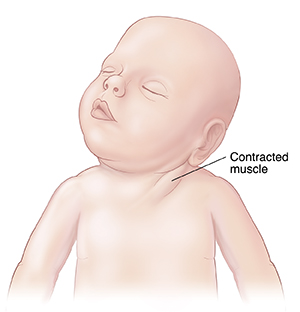
Your newborn has congenital muscular torticollis, a harmless and very treatable condition. Congenital means present at birth. Torticollis is twisting or bending of the neck. In this case, the bending is due to a neck muscle that is too tight or too short. This muscle pulls on the head and causes the head to turn and bend to the side. Torticollis is also called wry neck or twisted neck. Your child may see a pediatric orthopedist (doctor specializing in treating bone and joint problems in children) for an evaluation.
What causes congenital muscular torticollis?
It's not clear why some children are born with muscular torticollis.
Possible causes include:
-
Tightening of the neck muscle due to the position of the baby’s head in the uterus during pregnancy
-
Problem with the development of a muscle in the neck, causing it to be shorter than normal
-
Damage to a muscle in the neck during childbirth
Regardless of the cause, congenital muscular torticollis results from a shortened neck muscle that causes the neck to tilt toward the affected side.
What are the signs of congenital muscular torticollis?
Signs of this postural deformity may be noticed at birth. Or it may not be noticed for a few days or weeks. The signs include:
-
The infant’s head tilts to the side of the tight muscle, with the chin turning toward the opposite side.
-
A lump in the neck muscle on the shortened side.
-
Decreased range of motion of the neck and a fixed postural stiff neck due to the restricted or fixed muscle.
-
Flattening of one side of face.
This condition isn't painful. Your child will likely have no discomfort.
How is congenital muscular torticollis diagnosed?
An exam is often enough to diagnose the condition. The diagnosis may be confirmed with one or more of these imaging tests:
-
X-ray. This is done to check the bones of the neck and shoulders and rule out other problems.
-
Ultrasound. This makes images formed by sound waves. It's done to show the neck muscles.
-
MRI. This is done to show the neck muscles.
How is congenital muscular torticollis treated?
-
Congenital muscular torticollis most often goes away on its own by the time the child is 1 year of age. During this time, exercises help stretch the muscles. Your child may see a physical therapist (PT) for stretching. The PT will also teach you exercises to do with your child at home. The PT can teach you how to put the child in positions that force them to stretch the muscle on their own, and they may teach you some specific stretching exercises.
-
If conservative measures don't work, surgery may be advised.
-
The child should see their health care provider for regular checkups to make sure no further problems have developed.
-
If the muscle does not loosen on its own by
11 months of age, surgery may be needed. This is done to release and lengthen the tightened muscle and relieve the pulling.
What are the long-term concerns?
With treatment, a child with this condition will usually have no long-term problems. But the tight muscle may cause your child to lie on one side. This can result in flattening of the head on that side. This flattening is harmless and will usually go away over the next few years. Contact the health care provider if you have concerns about the torticollis getting worse.
Online Medical Reviewer: Marianne Fraser MSN RN
Online Medical Reviewer: Raymond Turley Jr PA-C
Online Medical Reviewer: Vinita Wadhawan Researcher
Date Last Reviewed: 01/01/2025
© 2000-2025 The StayWell Company, LLC. All rights reserved. This information is not intended as a substitute for professional medical care. Always follow your healthcare professional's instructions.