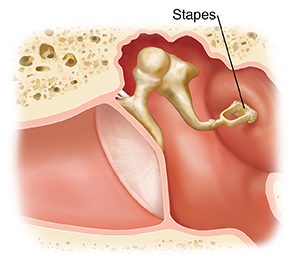
Otosclerosis is a disease that causes abnormal bone growth in the middle ear. The bones slowly become spongelike (otospongiosis) at first. But with time, the areas begin to harden (otosclerosis). As this happens, the middle ear bone, called the stapes, becomes stuck in place. The bone can't move correctly in response to sound. As a result, sound waves can't travel normally to the inner ear. This affects hearing. Symptoms often develop when a person is between the ages of 10 and 45, but it is most common in people in their 20s.
How to say it
oh-toh-skleh-ROH-sihs
What causes otosclerosis?
The exact cause of otosclerosis is still being studied. The disease tends to run in families. In some cases, it may be related to having had measles. It may also occur along with certain autoimmune disorders. These are diseases in which the body attacks its own tissues. Pregnancy can make the condition worse. Otosclerosis is more common in women than men. This suggests that sex hormones may have a role in causing the condition.
Symptoms of otosclerosis
The main symptom of otosclerosis is hearing loss that slowly gets worse. You may lose hearing in one or both ears. You may also have roaring, buzzing, or ringing sounds in the ear (tinnitus). In some cases, you may have dizziness or problems with balance.
Treatment for otosclerosis
Otosclerosis may be mild to severe. It may stop getting worse on its own or keep progressing. Treatment will depend on what type of hearing loss you have and how bad it is. There are currently no medicines available. The main treatments are:
-
Hearing aids. You wear these on or in the ear to help restore hearing.
-
Surgery (stapedectomy). This is done to remove the stapes bone and replace it with an artificial bone. The procedure can help restore some hearing.
When to contact your doctor
Contact your health care provider right away if:
-
Your symptoms get worse.
-
You have any new symptoms.
Author: Michels, Karen
Online Medical Reviewer: Jessica Gotwals RN BSN MPH
Online Medical Reviewer: Melinda Murray Ratini DO
Online Medical Reviewer: Shaziya Allarakha MD
Date Last Reviewed: 03/01/2025
© 2000-2026 The StayWell Company, LLC. All rights reserved. This information is not intended as a substitute for professional medical care. Always follow your healthcare professional's instructions.