Sound moves through the air like the ripples you see after throwing a stone into a pond. Your ears collect these waves of sound around you and send them to your brain. This is how the parts of your ear work so you can hear.
Three parts of your ear
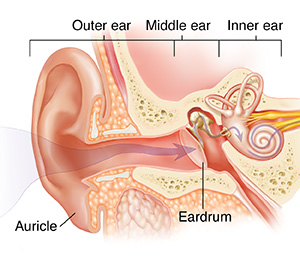
Your ear is made up of the following parts:
-
Your outer ear collects sound waves.
-
Sound waves enter the ear and hit the eardrum in your middle ear. Three tiny bones in the middle ear are set into motion.
-
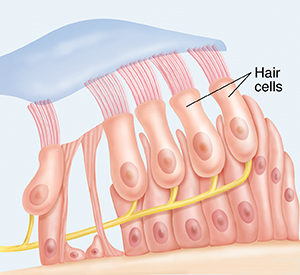
This transfers sound waves to the fluid-filled inner ear. There, thousands of hair cells turn sound waves into nerve impulses. These impulses travel along nerves to your brain. When the impulses reach your brain, you perceive sound.
Damaged hair cells affect hearing
Hair cells move when incoming sound vibrates the inner ear fluid. The motion is turned into impulses that let you hear the sound.
Loud noise causes hair cells to move too much and can damage them. Flattened hair cells can't fully send nerve impulses to your brain. Once damaged, hair cells never recover.
Online Medical Reviewer: Daphne Pierce-Smith RN MSN
Online Medical Reviewer: Marianne Fraser MSN RN
Date Last Reviewed: 07/01/2025
© 2000-2026 The StayWell Company, LLC. All rights reserved. This information is not intended as a substitute for professional medical care. Always follow your healthcare professional's instructions.