What is effective sucking?
During effective sucking (nutritive sucking), your baby's mouth compresses the milk ducts in your breast. When your baby is "latched on" the correct way, both lips should cover nearly all of your areola. This creates a vacuum to move milk to the back of the baby's throat to swallow. At first, your baby may seem to suck in quick bursts to trigger milk let-down. Once let-down happens, your baby should suck at the rate of about one suck a second. The baby pauses only to take a breath with every few sucks.
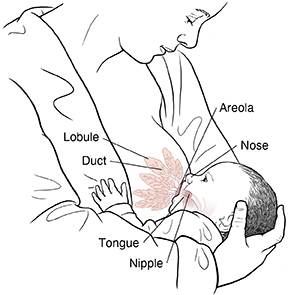
-
Listen for swallowing. You should hear a "huh-ah" or soft "k" sound deep in the baby's throat as they suck. Some babies have low pitched swallow sounds while others gulp loudly. You should not hear a clicking or smacking sound.
-
Watch your baby's jaw. You should see rhythmic movement in the muscle that runs from the lower jaw to the ear when your baby is sucking deeply. You should also notice rhythmic movement that begins at the edge of the baby's chin. This travels down their throat as your baby sucks and swallows. You should not see deep dimpling in your baby's cheeks.
Let your baby direct the feedings. Your baby will detach from your breast when satisfied. This may be about 15 to 20 minutes at each breast. Try to have your baby nurse from both breasts at each feeding.
Talk with your baby's healthcare provider or a certified lactation consultant if your baby:
-
Often falls asleep at the breast within a few minutes of latch-on
-
Often breastfeeds for 35 minutes on the first breast without self-detaching
Featured in
Online Medical Reviewer: Heather M Trevino BSN RNC
Online Medical Reviewer: Marianne Fraser MSN RN
Online Medical Reviewer: Rita Sather RN
Date Last Reviewed: 01/01/2024
© 2000-2026 The StayWell Company, LLC. All rights reserved. This information is not intended as a substitute for professional medical care. Always follow your healthcare professional's instructions.